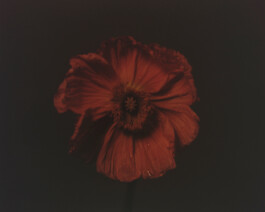
In their collaborative work "Thinking Anew," philosophers Lucy Irigaray and Michael Marder write:
"We must return to our sexual identities and learn to inhabit them as a foundation from which we can relate to our environment, to others, and above all, to ourselves. Rather than relying on external technological apparatus—what Heidegger called 'Gestell'—we can approach wholeness through our morphology, which corresponds to our sexual identities. Without reducing these identities to a neutral individualism, we can preserve and cultivate our natural energies.
Moreover, embracing our gendered nature provides additional energy that allows us to resist the homogenizing force of undifferentiated technological power and construct a relational human world capable of peaceful coexistence without domination or exclusion of other living beings."
Building on this investigation of sexual identity, Karen Paulina Biswell has spent years weaving deep connections with the plant world, now fully embracing it as an ally in her artistic practice. Like feminine sexuality, the plant world has always been shrouded in mystery. Saint Thomas Aquinas declared "Vita in plantis es occulta" (life in plants is hidden), and as Michael Marder explains, these hidden memories give rise to totemism and fertility rituals.
But Karen's works, far from being archaic throwbacks, open onto the origins of a new feminism—one that is more phenomenological than societal. In her series ELLAS (meaning "they" in the feminine form), she photographs women displaced into exterior spaces, freed from all markers of sociological assignment or social classification. No external pressure constrains them, allowing the reality of their power to manifest in this "here and now."
These heroines of infinite possibility—divine women in the sense of a divinity without beginning or end—are photographed as enthroned queens. In their centered stillness, animal intelligence and plant knowledge merge and blur, simultaneously offering themselves while ready to claim the world and men's hearts. They are compelling through their latent capacity for instantaneous transformation, where the song of Eros begins.
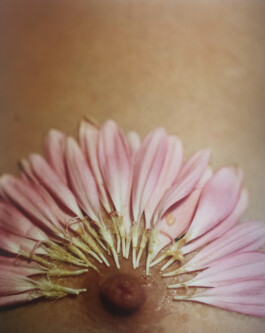
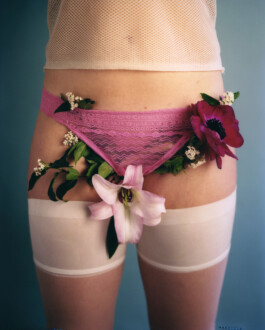
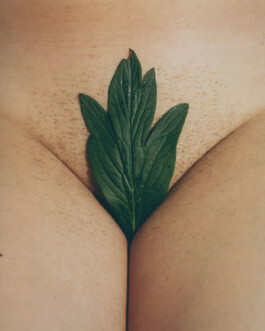

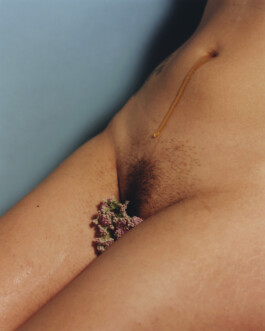
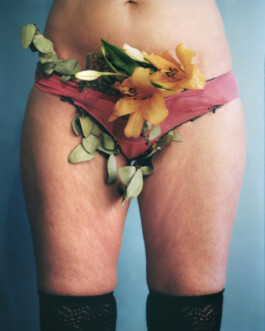
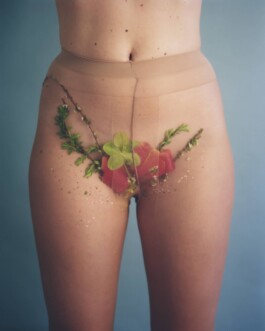
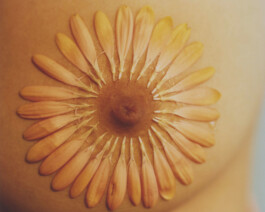


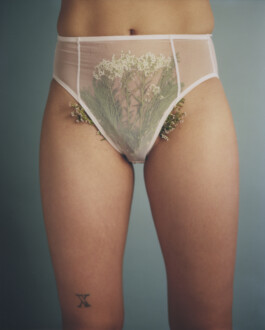

What we know of women's desire is often that we know nothing, or very little. This is the paradox of luxuriant flower petals existing within a culture of silence, where bodies secrete and sensibilities flourish through the constant work of active desire. This desire must be regarded with the utmost seriousness and respect, for our very survival depends on it today. Just as the plant's secret remains entirely vegetal, behind women's silence lies the key to all humanity's future. The objectifying attempts of our positivist sciences cannot penetrate this mystery. We can barely glimpse, through a half-open mouth, the germination of truth revealing itself in semi-darkness.Sophie Boursat
*Gestell: Heidegger's term describing what lies behind and beneath modern technology (The Question Concerning Technology, 1954)